Wireless infrastructure is no longer just a carrier request or technology upgrade. For property and venue owners, it is a real estate asset that affects tenant experience, operating resilience, lease economics, redevelopment flexibility, and long-term value.
That makes the key questions strategic: What infrastructure should be allowed? Who controls it? What economic rights should the owner preserve? And how can the property avoid being locked into an agreement that limits future value?
The answer starts with treating wireless rights like any other long-term property interest: define the strategy before giving away control.
Wireless Is Now Part of the Property
Owners often encounter wireless through a narrow request: approve a rooftop lease, upgrade a DAS, improve indoor coverage, add small cells, or evaluate private 5G. Each may look operational, but the long-term impact is financial and strategic.
- Better connectivity can improve tenant experience and building performance.
- Well-structured rights can create recurring revenue or future monetization opportunities.
- Poorly negotiated terms can restrict control, upgrades, access, redevelopment, or future economics.
Know Who Is Across the Table
Property owners are often negotiating with parties that understand wireless economics and technology better than they do. That information gap can shift value away from the owner.
Carriers, tower companies, neutral-host operators, DAS vendors, private-network providers, fiber providers, and system integrators all have legitimate roles, but different incentives. Their preferred structure may solve a coverage problem while limiting owner revenue, flexibility, or control.
Start With the Property Strategy
There is no universal best wireless solution. The right approach depends on property type, user density, carrier demand, building design, ownership horizon, capital plan, tenant needs, public-safety requirements, and monetization goals.
- Large venues may need neutral-host DAS or hybrid DAS/small-cell systems.
- Commercial buildings may benefit from small-cell or neutral-host models.
- Industrial, healthcare, campus, or logistics properties may need private LTE or private 5G.
- Rooftop or land sites may require stronger macro lease, amendment, colocation, and expansion economics.
Define the Requirements Before Selecting the Solution
Owners should not let a vendor define the problem. Start with outcomes, then compare technologies and deal structures.
Before evaluating Wi-Fi, DAS, small cells, private LTE/5G, neutral host, hybrid systems, or carrier-funded infrastructure, define:
- Coverage, capacity, and carrier participation goals
- Public-safety, redundancy, monitoring, and reporting requirements
- Cybersecurity, access, utility metering, upgrade, relocation, and handover rights
Protect the Economics and Control Rights
Base rent is only one part of the value equation. Owners should also evaluate escalators, renewal resets, amendment fees, equipment additions, ground space, utility reimbursement, generator access, colocation revenue, relocation costs, restoration obligations, and guarantees.
Contract language matters. Broad “upgrade,” “replacement,” or “modification” rights can let a carrier increase equipment, power use, rooftop congestion, cabinet needs, or operational burden without properly compensating the owner.
Owners should also be cautious with rights of first refusal, rights of first offer, easements, perpetual access, exclusivity, broad assignment rights, and carrier-friendly termination clauses. These terms can reduce leverage in a sale, refinance, redevelopment, or monetization.
Think Carefully Before Selling Future Rights
Lease buyouts and easements can provide immediate capital, but the headline offer is not the full valuation. Owners should compare the offer against expected lease income, escalations, renewal probability, amendment income, colocation potential, utility recovery, redevelopment plans, termination risk, site scarcity, and carrier strategy.
Preserve Future Optionality
Future-proofing does not mean predicting every technology change. It means preserving the owner’s ability to adapt as carriers, tenants, networks, and property plans evolve.
That requires planning for space, power, fiber, roof rights, equipment rooms, cooling, backup power, access protocols, cybersecurity, interference management, and operational responsibility. It also requires avoiding unnecessary exclusivity that limits competition or future value.
Owner’s Checklist
Before approving a wireless lease, DAS upgrade, small-cell deployment, private-network proposal, neutral-host agreement, buyout, or easement, ask:
- What problem are we solving?
- Who owns and controls the infrastructure?
- Who pays for power, upgrades, maintenance, relocation, and restoration?
- Who receives revenue from carriers, subtenants, amendments, or expansions?
- What rights remain if the property is sold, refinanced, redeveloped, or repositioned?
The Bottom Line
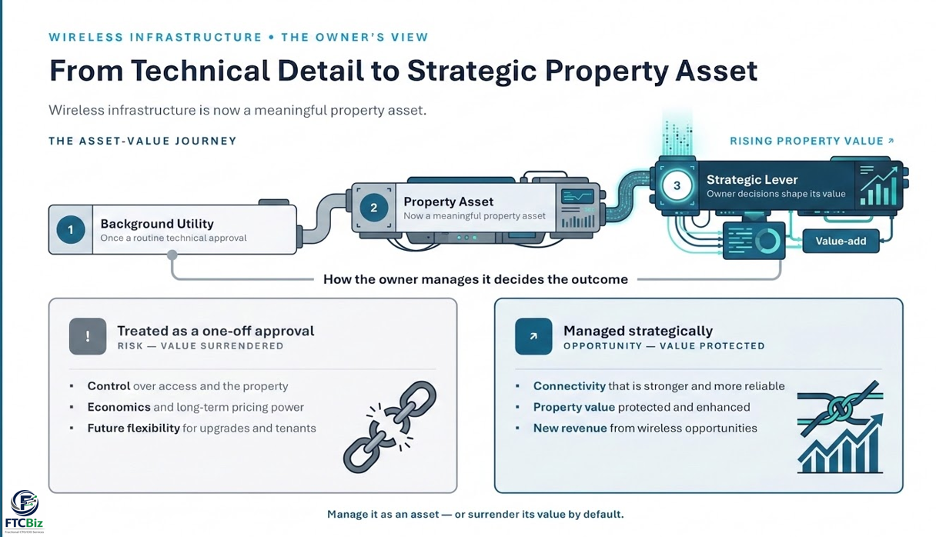
Wireless infrastructure is now a meaningful property asset. Owners who treat it as a one-off technical approval risk giving away control, economics, and future flexibility. Owners who manage it strategically can improve connectivity, protect property value, and create new revenue opportunities.
Written by the FTCBiz Strategy Team